
A Frightening Morning Becomes a Story of Gratitude
November 17, 2026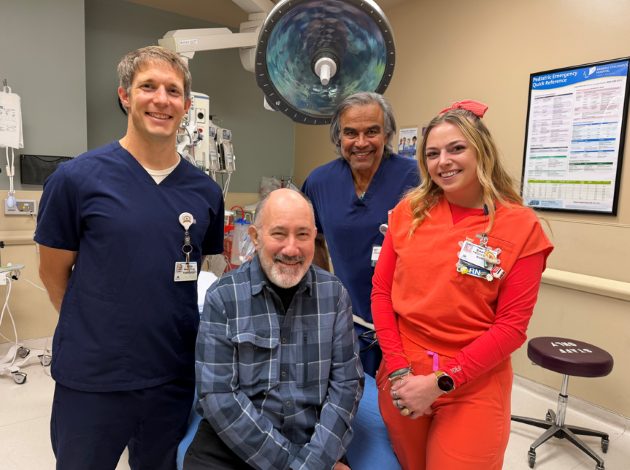
When Steve Randall woke early on March 27, he immediately knew something was wrong. He reached toward his nightstand but could not move his left arm or hand. With his family out of town, knowing he needed medical attention immediately, he drove himself to the emergency department.
“I shouldn’t have driven,” Steve acknowledged. “I was scared, my family was on a trip, so I drove myself.”
Steve was experiencing symptoms of a transient ischemic attack, or TIA, caused by a temporary disruption of blood flow to part of the brain. A TIA can produce sudden symptoms similar to those of a stroke and requires immediate medical attention.
While the situation was serious, Steve quickly gained confidence in the care team after arriving at Willamette Valley Medical Center.
“This is a remarkable hospital with big capabilities here in little old McMinnville,” Steve said. “I was stunned by the quality of care and the amount of equipment available. We are blessed to have a hospital like this in a town our size.”
Fast Decisions and Connected Care
Semara, RN, and Dr. Carlon quickly assessed Steve’s symptoms and ordered computed tomography angiography, or CTA. This specialized CT scan uses contrast dye to produce detailed images of blood vessels and can help identify blockages, clots, aneurysms, and other concerns.
The care team also used telemedicine technology to connect with a stroke specialist in Portland. The equipment allowed the physicians to review Steve’s condition and CTA findings in real time, discuss the seriousness of his symptoms, and determine the appropriate next steps for his care.
“Both doctors and I talked about what was happening to me, the severity of it, and where my care should take place,” Steve recalled. “I can laugh now, but back then I told them, ‘You just tell me, docs, what needs to happen, and I’m all in.”
Together, they determined that Steve could remain at Willamette Valley Medical Center for continued care.
A Team Supporting Every Part of Recovery
Steve was admitted to the hospital and closely monitored for several days. During that time, his care involved specialists from across the hospital, including cardiology, radiology, nutrition, physical therapy, and speech therapy. He also underwent multiple tests and began a therapy regimen designed to support his recovery.
One assessment remains especially memorable to Steve. A speech therapist evaluated his ability to swallow safely, an important consideration following stroke symptoms.
“I was asked by Ulla, the speech therapist, to eat a cookie while she evaluated my swallowing,” Steve said with a chuckle. “Easiest test! Luckily, my trouble swallowing was temporary.”
Within a few days, Steve’s symptoms had improved enough for him to transition to a skilled nursing facility. The hospital’s case management team coordinated the details of his discharge and the next stage of his recovery.
After two weeks of continued improvement, Steve was ready to return home. Because of the care he had received at Willamette Valley Medical Center, he advocated with his primary care provider to continue his physical therapy close to home in McMinnville.
Finding Strength and a Voice in His Recovery
Steve now works with Nate in physical therapy each week, focusing on his balance, stamina, and strength. Just as importantly, Steve feels heard and included in the decisions guiding his recovery.
“Nate regularly asks me, ‘What’s your goal?’” Steve said. “I appreciate that I am part of the decision-making process and can help guide my recovery.”
Looking back, Steve remembers the fear he felt when he first entered the emergency department. Today, that fear has been replaced by gratitude for the people, technology, and coordinated care that supported him throughout his journey.
“I was terrified when I came into the emergency department, and I quickly realized this is a top-rate hospital,” Steve said. “McMinnville is not a big city, but we have a hospital with capabilities you might expect to find in much larger communities. We are very lucky. I am very lucky, and I am thankful for all their expertise.”